Reliable heating diagnostics, steam restoration, and hydronic boiler service throughout Brooklyn Heights. From historic brownstones near Montague Street to row houses and apartments by the Brooklyn Heights Promenade, we diagnose and solve complex boiler breakdowns.
The historic architectural character of Brooklyn Heights means heating configurations vary widely from building to building. Most 19th-century brownstones and classic pre-war brick buildings were designed around low-pressure steam boiler repair Brooklyn Heights Brooklyn systems. These rely on boiling water to generate steam that travels through single-pipe or two-pipe networks, venting air at each cast-iron radiator before condensing back into water that returns to the boiler.
Conversely, modern renovations and newer residential multi-family structures frequently utilize hot water boiler repair Brooklyn Heights Brooklyn configurations, often referred to as hydronic heating. These closed-loop systems pump heated water through baseboard convectors, radiant floor tubing, or modern wall radiators using mechanical circulators. Understanding the exact dynamics of whether your property runs on vapor steam or pressurized hot water is the first step in successful troubleshooting.
Whether your equipment operates on natural gas or an older fuel system requiring gas boiler repair Brooklyn Heights Brooklyn, precision diagnosis of burner operation, draft conditions, and electrical limit controls ensures safe and balanced warmth throughout the building.
Catching heating irregularities early prevents total mid-winter heating failures and protects delicate cast-iron components from irreparable structural stress.
When faced with a sudden no heat boiler repair Brooklyn Heights Brooklyn event, the system may have entered a safety lockout. Tripped low-water cutoffs, malfunctioning ignition modules, or pilot interruptions require systematic isolation.
Review No-Heat Guide →Loud water hammer through floors and walls indicates steam colliding with trapped condensate in sagging headers or misaligned branches. We inspect pipe pitch, main vents, and return loops to quiet the system.
Radiator & Valve Services →Water pooling on basement slabs often points to discharging temperature-pressure relief valves, leaking section push nipples, corroded drain valves, or failing circulator flange gaskets.
Hydronic Leak Tracing →If gauge glass water surges erratically or hydronic pressure climbs toward the 30 PSI relief valve threshold, waterlogged expansion tanks or dirty boiler water surging require immediate attention.
Preventive Maintenance →Boilers that ignite for only two minutes before shutting off repeatedly waste fuel and accelerate contactor wear. Flame sensor oxidation, oversized nozzles, or restricted chimney draft often cause this behavior.
Gas Piping & Burner Checks →When a residential boiler not working Brooklyn Heights Brooklyn situation leaves rooms uncomfortably chilly, our targeted evaluation pinpoints electrical, mechanical, and piping faults quickly.
Contact Our Team →Properties throughout the Brooklyn Heights Historic District, from Cranberry and Willow Streets down toward Joralemon and Atlantic Avenue, feature unique architectural intricacies. Many four-story brownstones have experienced partial retrofits over the decades, resulting in hybrid piping layouts where original cast-iron risers meet modern copper extensions.
Common neighborhood heating complications include:
We also provide dedicated heating assistance for residents needing boiler repair near Cobble Hill, boiler repair near Downtown Brooklyn, and boiler repair near DUMBO, understanding the historic building stock shared across these neighboring historic pockets.
Every safe and efficient boiler relies on an integrated network of safety and operational components:
Prevents dry-firing by cutting electrical power to the burner immediately if the water volume falls below the minimum safe water line.
Senses vapor pressure to turn the burner off at designated limits. The curled brass pigtail creates a water seal protecting delicate diaphragms from hot live steam.
Discharges excess pressure (15 PSI for steam, 30 PSI for hot water) to protect cast-iron heat exchangers from rupture.
Regulates hydronic water temperature and distributes heated flow to individual building apartments or radiant loops.
We approach boiler troubleshooting with methodical engineering principles to identify the root failure rather than masking surface symptoms.
We begin by discussing your observations: when the symptoms started, noise patterns, water loss frequency, and any recent work performed. We verify the fuel supply and electrical isolation switches.
Our technician inspects the boiler exterior, burner tray, draft hood, flue breeching, safety relief valves, sight glass water clarity, and main supply headers for signs of stress, oxidation, or thermal fatigue.
We test critical safety devices, including electrical continuity across the low-water cutoff switch, pressuretrol calibration, high-limit aquastats, and automatic water feeder valves.
For gas-fired units, we verify manifold gas pressure, ignition sequence, flame rectification, thermocouple voltage, and exhaust draft conditions to ensure clean, soot-free combustion.
We clearly explain the exact component malfunction, outline repair options, replace failing parts with professional-grade components, and run the boiler through a complete heating cycle to verify balanced operation.
Property owners often wonder whether repairing an aging boiler makes economic sense compared to a full system modernization. Our recommendations are grounded in mechanical realities:
When Repair is Appropriate: Most boiler problems involve external electromechanical components that can be replaced economically. Issues like faulty ignition modules, blown transformers, failed water feeders, defective zone valves, seized circulator pumps, or weeping relief valves do not mean the boiler is ruined. If the cast-iron heat exchanger remains structurally intact and free of internal section leaks, repairing the unit is typically the most sensible and cost-effective approach.
When Replacement is Necessary: If the cast-iron sections have cracked, allowing flue gases into the basement or water to flood the combustion chamber, field welding is neither code-compliant nor safe in NYC. Furthermore, boilers exceeding 25 to 30 years with chronic scaling, severe metal fatigue, and decaying header piping often reach a threshold where cumulative repair bills surpass the cost of a modern, properly sized installation.
Learn more about equipment sizing, DOB permitting, and high-efficiency installation on our dedicated boiler replacement page.
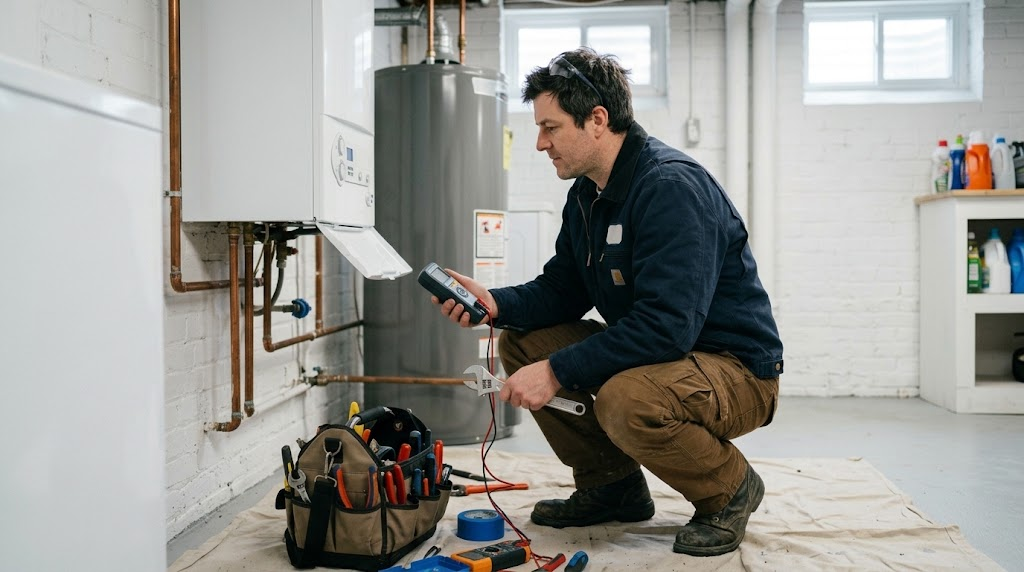
Beyond emergency boiler repairs, our specialized services keep your building's plumbing, gas, and heating infrastructure running reliably year-round.
Proper EDR radiation matching, cast-iron boiler installations, and oil-to-gas conversions meeting NYC Department of Buildings codes.
Explore Boiler Replacement →Eliminate radiator clanging, repair stuck shutoff valves, correct pipe pitch, and replace failed air vents for even room-by-room heating.
Explore Radiator Repair →Fast diagnosis for tank water heaters, tankless units, and indirect storage tanks linked to residential boiler coils.
Explore Water Heater Services →Qualified gas piping repairs, pressure tests, and compliance assessments under NYC Local Law 152 for covered residential buildings.
Explore Gas Line Services →Non-invasive moisture tracing, acoustic pipe testing, and thermal imaging to locate hidden leaks behind plaster walls and ceiling cavities.
Explore Leak Detection →Heavy-duty mechanical snaking and block clearance for slow drains, kitchen grease backups, and aging cast-iron house stacks.
Explore Drain Cleaning →High-resolution sewer camera inspections, line locates, and structural repairs for private laterals connecting to NYC street mains.
Explore Sewer Repair →Seasonal pre-winter safety inspections, boiler skim flushes, burner tuning, and safety limit checks to keep heating systems trouble-free.
Explore Maintenance Plans →Safe resident checklists and immediate diagnostic next steps when your boiler suddenly shuts down in freezing weather.
Explore No-Heat Guide →From the promenade walkways overlooking New York Harbor down to the bustling commercial corridors along Atlantic Avenue and Court Street, our primary service territory covers the entirety of Brooklyn Heights (11201).
We also provide routine and specialized heating services across adjacent Northwest Brooklyn neighborhoods including Cobble Hill, Downtown Brooklyn, DUMBO, Carroll Gardens, and Boerum Hill. Because these areas share similar brownstone architectures, pre-war apartment layouts, and aging heating pipe networks, our deep familiarity with local building styles ensures accurate and timely boiler repairs.
Explore our complete coverage map and building considerations on our service areas page.
View Service AreasProviding responsive boiler service across Brooklyn Heights, NY:
Clear, direct answers regarding residential heating repairs, brownstone steam systems, and professional diagnostics.
Loud knocking, commonly known as water hammer, occurs when high-velocity steam collides with pools of cooled condensate trapped within the pipes or radiators. In older Brooklyn Heights brownstones, this is frequently caused by radiators that have settled out of pitch (sloping away from the supply valve rather than toward it), sagging horizontal steam mains in the basement, failing or clogged radiator air vents, or overfilling of the boiler water level. Correcting radiator pitch, replacing defective quick-vent valves, and regulating boiler pressure typically quiets the system.
Start by checking the obvious electrical controls: confirm that the red emergency burner switch at the top of the basement stairs has not been inadvertently turned off and that the boiler's circuit breaker has not tripped. For steam systems, inspect the sight glass—if the water level has dropped below the minimum threshold, the automatic low-water cutoff will intentionally isolate the burner to protect the cast iron from cracking. Never attempt to force a boiler to fire if the low-water cutoff has tripped; call a qualified technician to verify the water feeder and safety circuits.
Historic Brooklyn Heights homes primarily rely on gravity-return single-pipe steam systems installed over a century ago. These systems rely strictly on natural thermodynamic draft and gravity, operating best at ultra-low pressures (often between 0.5 and 1.5 PSI). Modern forced-air or hydronic systems, by contrast, use mechanical fans or circulating pumps. Tuning an antique steam system requires understanding boiler steaming rates, main venting capacity, and pipe slope rather than simply turning up the pressure control.
If the failure involves electromechanical accessories—such as the gas valve, thermocouple, spark ignition module, pressure switch, water feeder, circulator motor, or relief valve—the equipment can almost always be repaired reliably. However, if the cast-iron heat exchanger sections are cracked, allowing water into the combustion chamber or flue gas into the cellar, replacement is mandatory because section repairs are neither safe nor code-compliant in New York City.
Speak directly with a skilled technician to diagnose heating failures, resolve radiator banging, or restore steady warmth to your building.
Call (315) 202-8009 to Discuss Boiler Repair