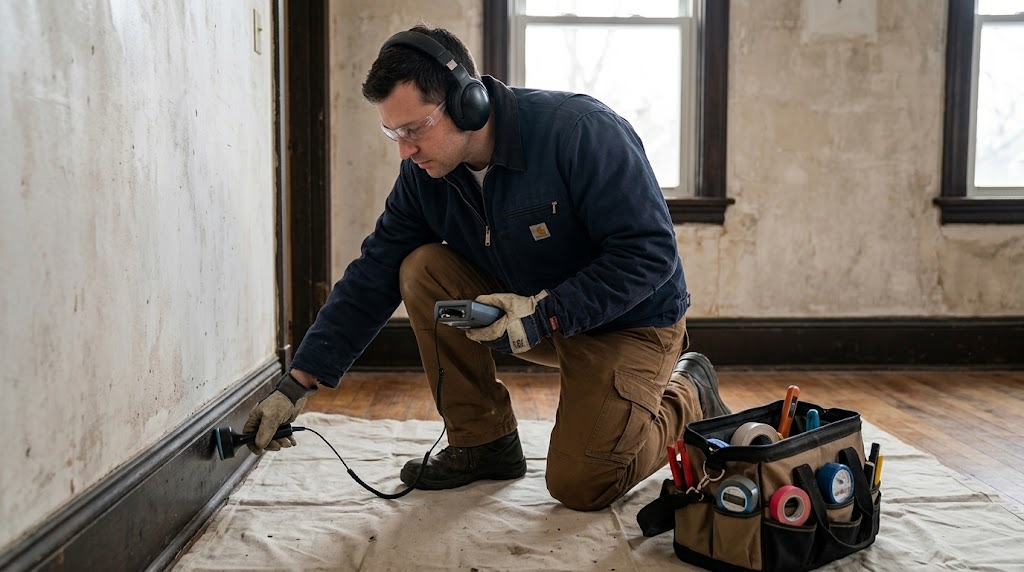
Locate hidden water leaks behind historic plaster, beneath tiled floors, and through brownstone ceiling cavities without unnecessary property damage.
Call (315) 202-8009 for Leak Tracing
Water leaks in historic Brooklyn Heights brownstones and pre-war apartments are notoriously deceptive. Water rarely drips straight down; instead, it travels along wooden floor beams, wraps around conduit lines, and emerges yards away as an unsightly blister on a decorative plaster ceiling. Providing accurate leak detection Brooklyn Heights Brooklyn requires advanced diagnostic instruments to isolate the genuine failure point.
Whether you are dealing with an urgent water leak from upstairs apartment Brooklyn Heights Brooklyn in a multi-story cooperative or suspect a slow hidden water leak detection Brooklyn Heights Brooklyn scenario causing wood floor warping, our non-invasive protocol protects architectural finishes from needless demolition.
From specialized apartment leak detection Brooklyn Heights Brooklyn to targeted ceiling leak repair Brooklyn Heights Brooklyn and leak in wall detection Brooklyn Heights Brooklyn, we trace the source quickly and execute tidy, code-compliant pipe repairs.
Combining thermal optics, acoustic frequencies, and pressure isolation to find leaks without tearing apart walls.
Infrared cameras detect subtle temperature differentials caused by evaporative cooling or hot water escape behind plaster, revealing invisible moisture patterns behind finished surfaces.
High-gain acoustic ground microphones and contact probes amplify the distinct hissing frequency generated by pressurized water escaping through a pinhole crack in copper or brass pipes.
We isolate individual plumbing branches—hot domestic, cold domestic, hydronic boiler zones, and gravity waste stacks—to scientifically prove which piping network is losing pressure.
A systematic diagnostic workflow engineered to protect historic brownstone interiors.
We map the affected ceiling or wall with non-penetrating digital moisture meters to establish moisture gradient patterns and determine the wettest epicenter.
We test whether the leak corresponds to boiler operation or runs 24/7. Water supply lines are pressure-tested; fixture drains and bathtub overflow gaskets are dye-tested to isolate drain leaks.
Using thermal infrared cameras and ultrasonic listening equipment, we trace pipe paths within wall chases to triangulate the exact point of pipe failure.
Rather than tearing out large sections of wall, we make a neat, minimal exploratory inspection cut directly at the triangulated leak site to visually inspect the damaged fitting.
We cut away the compromised copper, brass, or cast-iron section, install code-compliant replacement piping, pressure-test the line, and leave the area clean and prepared for drywall or plaster patching.
No ethical plumber can guarantee that every leak can be located without opening a wall. However, modern diagnostics dramatically reduce exploration damage. Key project variables include:
Tracing hidden leaks often reveals related drainage and supply considerations:
Non-invasive technologies like acoustic listening devices, moisture meters, and FLIR thermal cameras narrow down the source significantly, but verifying the pipe and executing permanent physical repairs ultimately requires targeted surgical access to the affected pipe fitting. Our goal is to make a single 6-inch exploratory opening rather than tearing open multiple walls.
Water frequently travels horizontally along timber joists or electrical conduits before dripping through plaster. We isolate pressurized water lines, test bathroom fixture waste drains, check radiator valve connections above the leak zone, and run dye tests in showers and sinks to isolate the exact fixture or pipe branch.
Common causes include deteriorating galvanized steel nipple connections, cracked brass radiator spuds, failing lead-caulked cast-iron waste hubs, and vibration fatigue in concealed copper joints that rub against rough framing nails over decades.
Boiler heating leaks often correlate directly with heating cycles—appearing when pipes expand with hot water or steam—whereas domestic pressurized water supply leaks drip continuously 24 hours a day regardless of heating status. Heating system leaks also frequently display dark or rusty water compared to clear domestic supply water.
Speak with our leak detection specialists to locate water intrusion non-invasively and protect your property.
Call (315) 202-8009 to Schedule Leak Tracing