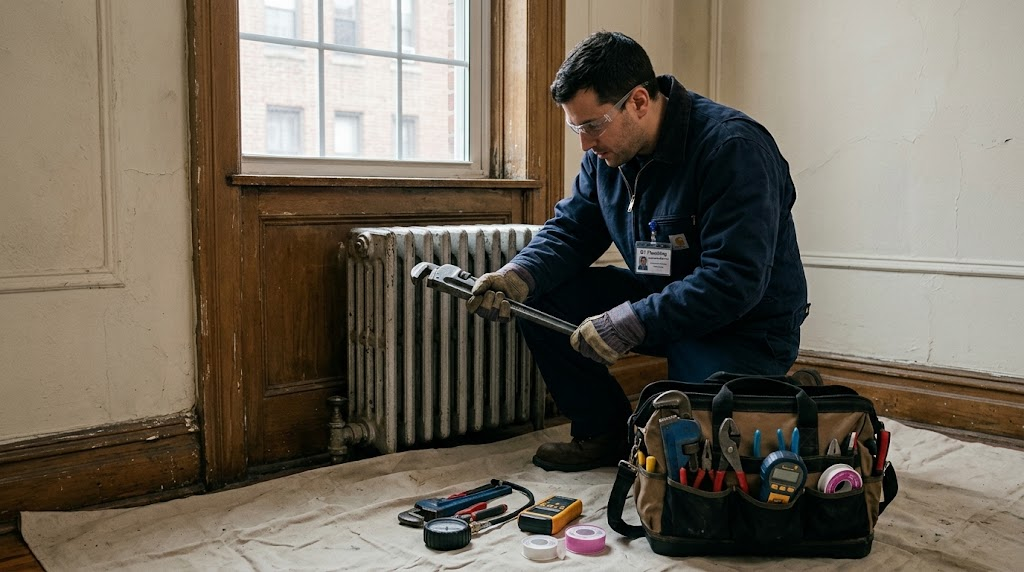
Quiet banging pipes, fix leaking shutoff valves, correct radiator pitch, and balance uneven heat throughout historic brownstones and co-op apartments.
Call (315) 202-8009 for Radiator Service
When winter temperatures drop along the East River, nothing matches the radiant warmth of a well-tuned cast-iron steam radiator. However, in historic Brooklyn Heights brownstones, age, settlement, and improper retrofits often cause systems to become loud, uneven, or prone to leaks. Providing expert radiator repair Brooklyn Heights Brooklyn requires mastering the delicate physics of steam flow and condensate return.
Two of the most frustrating winter heating complaints are violent banging steam pipes Brooklyn Heights Brooklyn and rooms that remain freezing while other apartments overheat. We systematically diagnose pipe slope, vent orifice sizing, and valve seals to restore whisper-quiet heating across every floor.
Whether your home requires a complete steam radiator valve replacement Brooklyn Heights Brooklyn, new thermostatic radiator valves (TRVs) for zone comfort, or repacking weeping valve stems that damage hardwood flooring, our specialized service brings relief.
Understanding steam distribution mechanics is essential to permanently eliminating noise and cold spots.
In a single-pipe steam radiator, steam enters and condensate exits through the exact same pipe. The radiator must pitch slightly downward toward the supply valve (approximately 1/4 inch per 10 feet). If floor joists settle and the radiator tilts backward, water puddles inside, causing severe water hammer.
Cold radiators are full of air when the cycle starts. Steam cannot enter until air is vented out. By installing adjustable air vents with calibrated venting rates, we balance heat distribution so distant upper-floor rooms warm up at the exact same pace as lower levels.
A common brownstone misconception is that you can throttle heat by turning the radiator valve half-shut. In single-pipe systems, this narrows the passage, trapping water inside and destroying the valve seat. For modulating comfort, we install specialized 1-pipe thermostatic radiator valves.
Restoring quiet, efficient steam flow through precision inspection and component replacement.
We check each cast-iron radiator with precision levels to confirm proper downward slope toward the return riser, shimming radiator feet with durable brass or composite shims if historic floor settling has reversed the pitch.
We test the radiator supply valve for internal stem wire-drawing, worn discs, or seized threads. If leaking around the stem, we repack the gland; if the internal brass spud or union face is damaged, we replace the valve assembly.
We verify the condition of the radiator vent and inspect the basement steam main quick-vents. Without functioning main vents, steam moves sluggishly through the risers, causing radiators to heat unevenly.
If a radiator exhibits heavy sludge or scale deposits choking the lower internal ports, we isolate the unit, disconnect the union, and flush accumulated rust out to restore full heat transfer.
We fire the boiler, trace steam velocity into the radiators, verify that air vents seal tightly the instant steam reaches them, and verify that no knocking occurs during the condensation phase.
Historic cast-iron radiators are virtually indestructible and possess superior heat-retention properties compared to modern baseboards. In the vast majority of cases, replacing valves, vents, and piping restores them to peak performance without needing to remove the heavy iron casting.
However, if a radiator has frozen during an unheated vacancy, water expanding into ice can crack cast-iron sections along push nipple joints. When cast iron cracks, epoxy or surface sealant repairs will inevitably fail under thermal expansion. In those circumstances, sourcing a salvaged architectural cast-iron unit or installing a modern slim-profile column radiator is the appropriate choice.
Learn more about total heating plant overhaul on our boiler replacement page or explore seasonal checks on our boiler maintenance page.
Banging steam pipes Brooklyn Heights Brooklyn typically occur due to water hammer. In single-pipe steam systems, incoming steam collides with pools of condensed water trapped inside the radiator or run-out pipe. This is usually caused by incorrect radiator pitch (sloping away from the valve rather than toward it), a partially closed valve restricting drainage, or boiler pressure running too high. Shimming the radiator and inspecting the valve usually eliminates the sound completely.
No. On a standard single-pipe steam system, the radiator shutoff valve must be either 100% fully open or 100% tightly shut. A partially closed valve restricts the return of condensed water, trapping water inside the radiator, causing violent knocking, leaking valve packing, and spurting air vents. If you wish to modulate temperature, install a specialized 1-pipe thermostatic radiator valve (TRV) or an adjustable air vent.
The most common culprit is a clogged, paint-sealed, or corroded radiator air vent. If the vent cannot expel trapped room air, incoming steam cannot enter the cast-iron sections. Another common reason is a seized shutoff valve whose internal disc has detached from the stem in the closed position, even though the handwheel appears open.
Minor valve leaks around the stem can often be repacked with fresh Teflon packing graphite under the packing nut. If the brass valve body, internal spud, or union nut is cracked, the entire valve must be replaced while the system is cool. We carry heavy commercial brass steam valves sized specifically for vintage NYC radiator connections.
Speak with our heating specialists to restore quiet, balanced steam warmth to your Brooklyn Heights property.
Call (315) 202-8009 to Schedule Radiator Service